
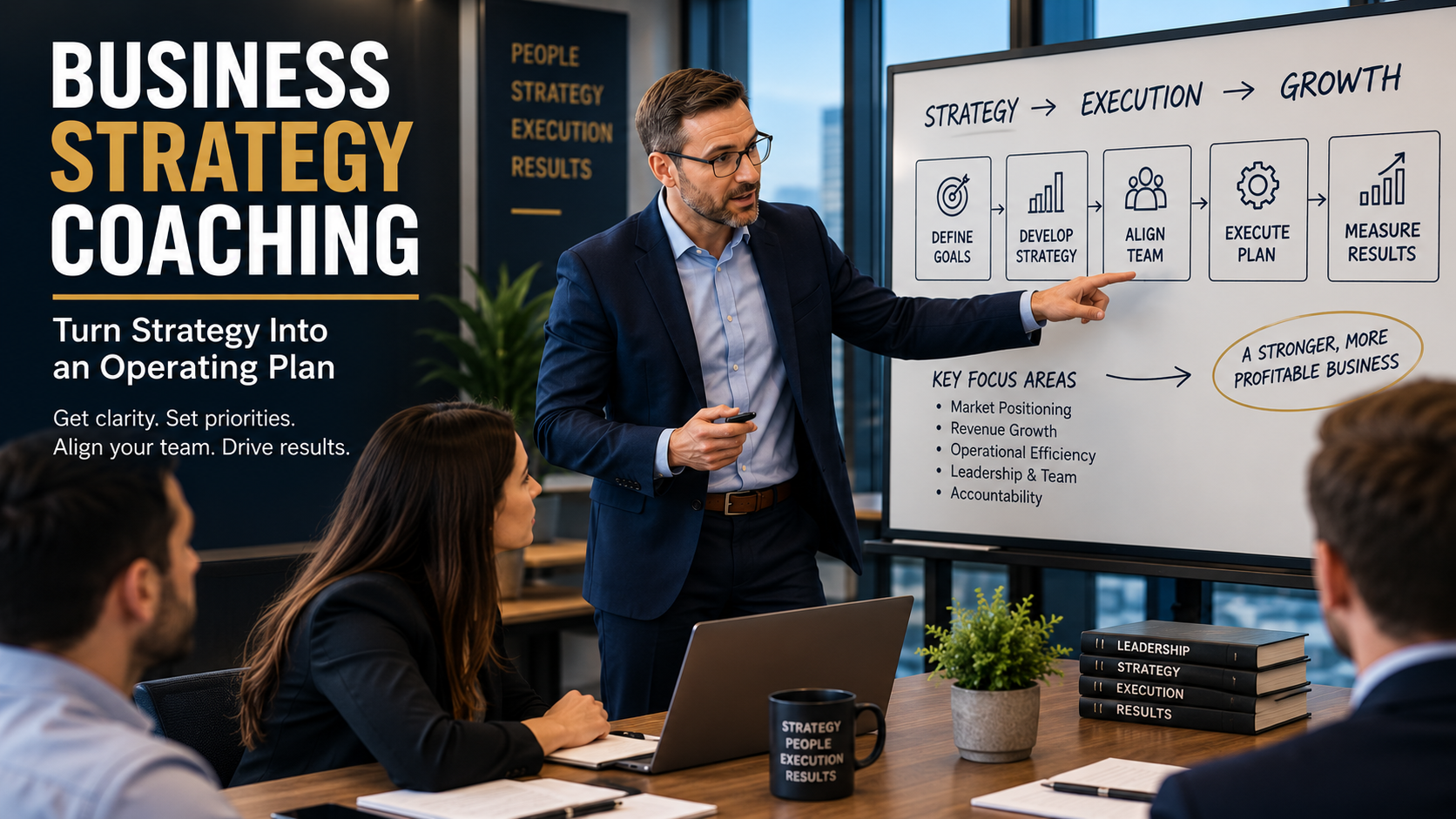
Most business owners do not have a shortage of ideas.
They have too many.
There are new markets to enter, products to improve, people to hire, systems to fix, campaigns to launch, customers to serve, and opportunities that all seem important at the same time.
The challenge is not usually coming up with another strategy.
The challenge is deciding what matters most, what should happen next, and what the business is willing to stop doing in order to execute well.
That is where business strategy coaching can create value.
A strategy coach helps a business owner or leadership team clarify direction, challenge assumptions, prioritize decisions, and translate broad goals into an operating plan that people can actually execute.
The work sits between high-level strategy and day-to-day management.
It is not simply brainstorming.
It is not motivational coaching.
And it is not a consultant handing over a 60-page strategy deck and leaving.
The objective is to create enough clarity that the business knows where it is going, why those priorities matter, who owns the work, and how progress will be measured.
Business strategy coaching is a structured process that helps owners and leaders improve how they think about direction, priorities, growth, and execution.
A strategy coach may help the business work through questions such as:
The coach does not make those decisions for the company.
The role is to improve the quality of the thinking behind them.
That often means challenging assumptions, forcing tradeoffs, and helping leadership move from vague ambition to specific action.
Many companies confuse goals with strategy.
A goal might be:
Grow revenue by 25%.
That is an outcome.
It is not yet a strategy.
A strategy explains how the business intends to create that outcome.
For example:
Focus on higher-value accounts.
Increase expansion revenue from existing customers.
Develop a more disciplined outbound sales process.
Improve retention.
Launch a new offer for a clearly defined segment.
Build a management layer so the founder is no longer the operating bottleneck.
Each one represents a different path.
The role of strategy is to choose.
If the company tries to pursue all of them equally, it may end up spreading attention too thin to execute any of them well.
Most strategy problems do not fail because the original idea was obviously bad.
They fail because the company never turns the idea into an operating system.
Leadership agrees on a direction during a planning session.
Then everyone returns to normal work.
Urgent requests take over.
Old priorities remain active.
New initiatives are added without anything being removed.
Managers interpret the strategy differently.
Nobody is sure which metric matters most.
Within a few weeks, the strategy becomes another document rather than a change in how the company operates.
Business strategy coaching helps close that gap.
The coach keeps asking:
What changes because of this strategy?
If nothing changes in priorities, resource allocation, management behavior, sales focus, or decision-making, the strategy probably has not become operational yet.
The exact role depends on the business, but several responsibilities are common.
Before creating a better strategy, leadership needs an accurate view of the current business.
That may include reviewing:
The objective is not to analyze everything.
It is to identify the realities that should influence the next decision.
Good strategy begins with an honest diagnosis.
Business owners naturally build assumptions over time.
“We need more leads.”
“We need another salesperson.”
“This customer segment is our best market.”
“We cannot raise prices.”
“Our team is already at capacity.”
“We need to launch this product.”
Some assumptions are correct.
Others were true three years ago and have never been reconsidered.
A strong strategy coach challenges those assumptions before they become expensive commitments.
The coach may ask:
What evidence supports that?
What would need to be true for this strategy to work?
What happens if the opposite is true?
What are we overlooking?
What is the cost of being wrong?
Those questions can prevent a company from solving the wrong problem.
Strategy requires saying no.
That is difficult for growing businesses because many opportunities are genuinely attractive.
The company may have five initiatives that could work.
But it may only have enough management attention, capital, and team capacity to execute two of them properly.
A strategy coach helps leadership distinguish between:
important, urgent, interesting, and strategic.
Those categories are not the same.
The goal is to identify the few priorities that deserve disproportionate attention.
Growth strategy and sales strategy should not operate separately.
If the company wants to move upmarket, the sales process may need to change.
If the business wants higher-margin customers, qualification criteria may need to change.
If leadership wants predictable recurring revenue, compensation and account-management behavior may need to change.
If the company wants to enter a new market, messaging, prospecting, sales training, and pipeline expectations may all need to change.
Ben Buckwalter's guide to building a predictable sales strategy reinforces this principle: strategy should clarify who you are targeting, why those customers should care, and how the team will consistently create and convert opportunities.
Business strategy determines the direction.
Sales strategy turns part of that direction into revenue.
This is where strategy becomes practical.
An operating plan translates broad priorities into:
Suppose the strategic priority is:
Reduce dependence on founder-led sales.
That needs to become concrete.
The operating plan might include:
Document the founder's sales process.
Define qualification standards.
Build a sales playbook.
Assign account ownership.
Train the team.
Create manager-led pipeline reviews.
Track conversion by rep.
Reduce the founder's involvement in standard opportunities over six months.
Now the strategy can be managed.
Without that level of translation, “reduce founder dependence” remains a good intention.
Important work is often displaced by urgent work.
A strategy coach helps prevent that.
Regular coaching creates a cadence for reviewing:
What did we commit to?
What happened?
What did not happen?
Why?
What changed?
What needs to happen next?
This accountability is especially useful for owners because there is often nobody inside the company who can challenge them consistently.
Employees may hesitate.
Partners may have their own priorities.
A coach can create an external discipline around commitments the owner has already decided are important.
A business strategy coach should help improve the process behind decisions, not simply provide more opinions.
That means helping leadership evaluate decisions using clear criteria.
For example:
Does this support our core strategy?
Does it move us toward our ideal customer?
Do we have the capacity to execute it?
What is the opportunity cost?
What assumptions are we making?
What could go wrong?
What would success look like?
How reversible is the decision?
These questions help prevent emotional or reactive decisions from dominating the strategy.
The two roles overlap, but there is an important distinction.
A business consultant is often hired to solve a defined problem.
The consultant may analyze the situation, design the solution, and recommend what the company should do.
A strategy coach is usually more focused on helping leadership improve how they make decisions and execute priorities.
The consultant may say:
“You should enter this market.”
The coach may ask:
“Why do you believe this market deserves priority over the alternatives, and what evidence would change your mind?”
One provides more direct prescription.
The other develops better strategic thinking.
Many experienced advisors combine both approaches.
The right model depends on whether the company needs expertise, decision support, execution discipline, or all three.
Business coaching is broader.
A business coach may work on leadership, accountability, habits, sales, team issues, confidence, delegation, and growth.
A business strategy coach focuses more specifically on strategic direction and execution.
The work may include business model decisions, market focus, growth priorities, resource allocation, organizational capability, and strategic planning.
In practice, the distinction can become blurry.
What matters is the coach's ability to help solve the problem the business actually has.
Strategy coaching can be valuable at several stages.
The founder is still involved in too many decisions.
Everything important flows through one person.
Growth creates more responsibility instead of more leverage.
A strategy coach can help the founder clarify which work only they should do and which responsibilities need to move into the organization.
The company is no longer failing.
But it is no longer growing the way it once did.
More effort is producing less incremental progress.
This is often the point where leadership needs to rethink the model rather than simply work harder.
A strategy coach can help identify the next constraint.
Everyone is busy.
Every department has initiatives.
But the organization lacks a clear hierarchy of priorities.
Strategy coaching can force alignment around what matters most.
That improves execution because teams are not constantly competing for attention.
A business moving from $1 million to $5 million in revenue faces different problems from one trying to move from $20 million to $50 million.
The systems, leadership structure, sales model, and management practices that created the current business may not create the next one.
Strategy coaching can help leadership identify what needs to evolve before growth exposes the weakness.
Strategy coaching can be useful before decisions such as:
The coach provides a disciplined decision process before the company commits significant resources.
A useful operating plan does not need to be complicated.
It should answer a few essential questions.
Be specific.
“Grow the business” is not enough.
A stronger objective might be:
Increase recurring revenue by 20% over the next 12 months while maintaining current gross margin.
Now the business can evaluate decisions against a concrete outcome.
Ask what conditions need to exist for the objective to become realistic.
The company may need:
better retention,
stronger sales capacity,
a different customer mix,
better pricing,
more management capability,
new technology,
or a new channel.
This exposes the assumptions behind the strategy.
Most companies can execute a small number of major priorities well.
Choose them deliberately.
A company trying to pursue twelve major strategic initiatives at once probably has no true priorities.
Every major initiative needs one clear owner.
Committees can support execution.
But ownership should not be vague.
When everyone owns something, nobody fully owns it.
Define the evidence of progress.
If the priority is sales-process improvement, track the metrics that reflect it.
Ben Buckwalter's article on sales KPIs for managers explains why measurement should help leaders make better decisions rather than simply create more reporting.
The same principle applies to strategic priorities.
This question is frequently ignored.
New priorities consume time.
If everything old remains active, the company does not actually have additional capacity.
A strategic operating plan should identify what will stop, shrink, or receive less attention.
That creates the capacity needed to execute the new direction.
Annual strategy matters.
But a year is too long for operating accountability.
A practical approach is to translate annual priorities into 90-day commitments.
At the beginning of the quarter, determine:
What are the most important outcomes for the next 90 days?
Who owns them?
What milestones should occur?
What numbers should move?
What risks could stop execution?
Then review progress throughout the quarter.
This creates a bridge between long-term direction and weekly work.
The right cadence depends on the business.
Weekly coaching may make sense during a major transition.
Twice monthly is common for ongoing strategic work.
Monthly may be enough for experienced leaders who primarily need perspective and accountability.
The frequency matters less than the quality of the operating rhythm.
There should be enough time between sessions to execute meaningful work, but not so much time that priorities drift for months without review.
Pricing varies widely according to the coach, company size, scope, access, and complexity of the engagement.
Some coaches charge hourly.
Others work on monthly retainers.
Some offer fixed strategic-planning engagements.
More experienced advisors working with larger companies generally charge more because the decisions involve greater economic stakes and complexity.
The relevant question is not simply the fee.
It is the value of the decisions being improved.
A strategy mistake can cost far more than a coaching engagement.
So can months of indecision.
Strategy coaching ROI can be harder to measure than a single marketing campaign.
But it should still connect to business outcomes.
Useful indicators may include:
revenue growth,
profitability,
execution speed,
leadership capacity,
strategic milestones,
sales performance,
retention,
decision quality,
reduced founder dependency,
and completion of major initiatives.
Some benefits are indirect.
If coaching helps the company avoid a bad hire, cancel a weak initiative before spending $200,000, or choose the right market to enter, the financial impact may be substantial.
The key is to define what improvement means before the engagement starts.
Strategy coaching becomes less useful when leadership treats it as passive advice.
Several mistakes appear frequently.
If the strategy changes but the team's work does not, execution has not changed.
A coach should help create focus, not simply create a longer to-do list.
Real strategy requires choosing between attractive alternatives.
A strategy that assumes unlimited people, money, and management attention is not an operating plan.
Projects without clear owners tend to drift.
A small number of meaningful metrics is more useful than a dashboard containing every available number.
Look for someone who can combine strategic thinking with practical execution.
Ask:
What kinds of strategic problems do you work on?
How do you diagnose a business?
How do you challenge assumptions?
How do you help clients prioritize?
How do you convert strategy into execution?
How do you measure progress?
How do you handle disagreement with a founder or CEO?
Do you have experience at our stage of growth?
The coach should be able to challenge you without turning the relationship into conflict.
Comfort is not the goal.
Better decisions are.
A strong coaching relationship should make leadership more capable over time.
The business should become better at:
setting priorities,
evaluating opportunities,
making tradeoffs,
assigning ownership,
measuring progress,
and making difficult decisions.
The coach provides leverage.
They should not become another approval layer.
Strategy without execution is theory.
Execution without strategy is activity.
The strongest businesses connect the two.
They know what they are trying to accomplish.
They know why those priorities matter.
They know what the team needs to do differently.
They review the evidence.
And they adjust when reality proves an assumption wrong.
That operating discipline is what turns strategy into growth.
Ben Buckwalter's broader approach to business growth emphasizes practical execution rather than strategy for its own sake.
A plan should help people make decisions.
It should clarify what matters.
It should make priorities visible.
And it should create enough structure that leadership can tell whether the organization is actually moving in the intended direction.
The same principle applies to sales.
A sales playbook is valuable because it turns an intended approach into something people can consistently execute.
A strategic operating plan should do the same thing at the business level.
Business strategy coaching is valuable when a company has ambition but needs greater clarity, prioritization, and execution discipline.
The best strategy coach does not simply provide more ideas.
They help leadership decide which ideas matter.
They challenge assumptions.
They force tradeoffs.
They connect high-level goals to operational changes.
And they create accountability around the work leadership has already decided is important.
A strong strategy should ultimately change how the business operates.
If it does not affect priorities, resources, ownership, metrics, or decision-making, it is probably still only an idea.
Business strategy coaching helps close that gap.
The goal is to move from:
“This is where we want to go.”
to:
“This is exactly what we are doing next.”
Business strategy coaching helps owners and leaders clarify strategic direction, evaluate opportunities, prioritize initiatives, improve decision-making, and turn business goals into executable operating plans.
A strategy coach challenges assumptions, helps leadership make tradeoffs, clarifies priorities, improves strategic decision-making, creates accountability, and helps translate broad goals into specific actions.
Consultants often diagnose problems and recommend solutions directly. Strategy coaches typically focus more on helping leadership improve its own decision-making, prioritization, and execution, although experienced advisors may use both approaches.
Strategy coaching can be useful for founders who have become bottlenecks, businesses experiencing a growth plateau, leadership teams with too many priorities, companies entering a new stage, or organizations preparing for major strategic decisions.
ROI may be reflected in revenue, profitability, execution speed, leadership capacity, strategic milestones, improved decision-making, reduced founder dependency, or the avoidance of costly strategic mistakes.

