
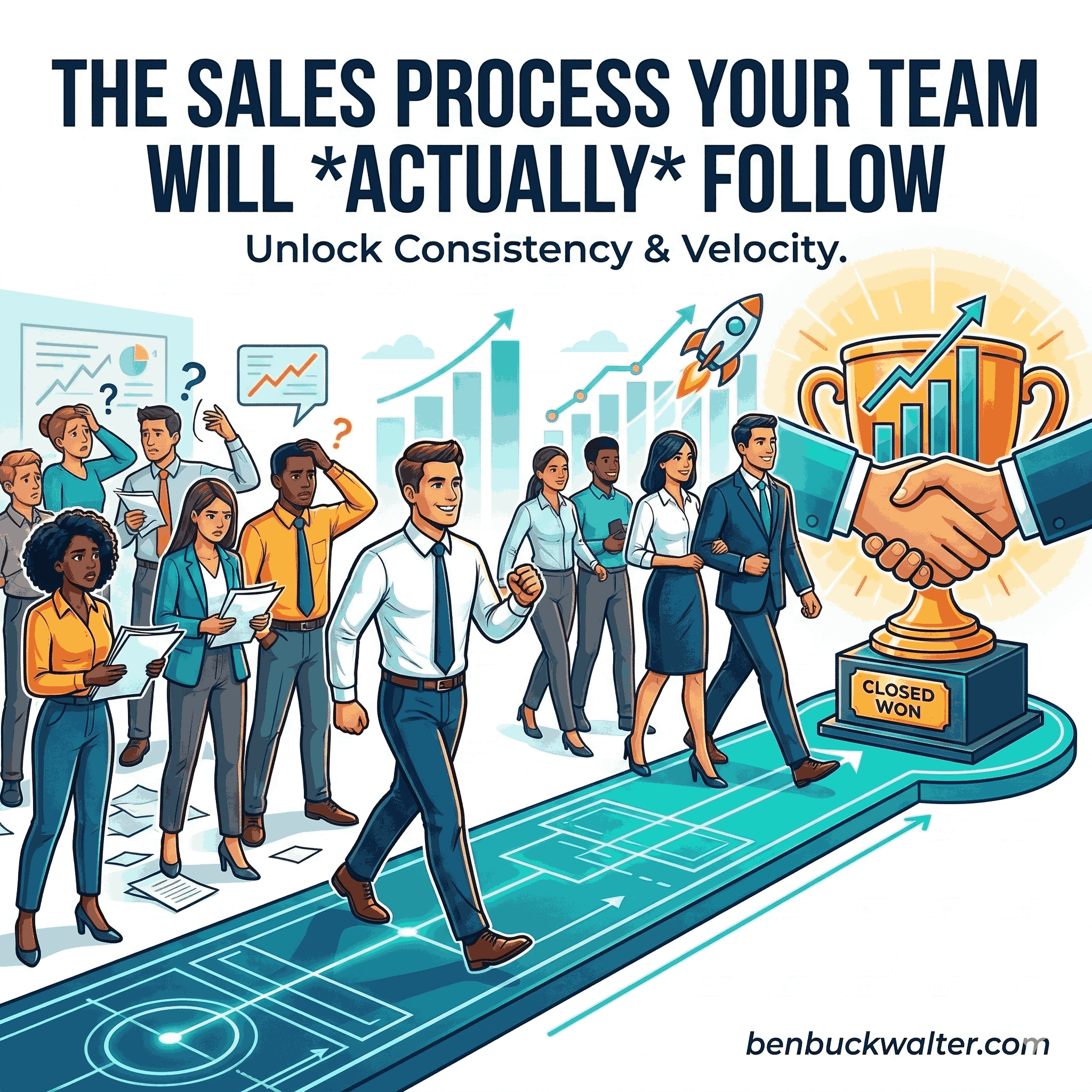
If you want more consistent sales results, you need more than effort. You need a sales process your team can actually follow.
That sounds simple, but this is where a lot of businesses get stuck. They know they need structure, but what they end up with is either too vague to be useful or too complicated to use in the real world. The result is predictable. Everyone sells a little differently, follow-up becomes inconsistent, good leads fall through the cracks, and revenue feels harder to control than it should.
A strong sales process helps fix that. It gives your team a clear path from first contact to closed deal. It makes performance easier to measure, coaching easier to deliver, and results easier to improve over time.
But here’s the key: the best sales process is not the one that looks impressive on a whiteboard. It’s the one your team actually uses.
A sales process is a repeatable set of stages that guides how your business moves a prospect from initial interest to a buying decision.
It is not the same thing as a script, and it is not just a CRM pipeline with a few labels attached. A real sales process gives people clarity on what needs to happen at each stage, what information needs to be gathered, what decisions need to be made, and what should happen next.
At its best, a sales process creates consistency without making your team sound robotic.
That matters because when salespeople are left to improvise everything, performance becomes unpredictable. Some deals move forward because the rep is naturally strong. Others stall because there is no structure holding the conversation together. A process helps reduce that randomness.
A lot of companies technically have a sales process, but it exists only in theory. It lives in a slide deck, a sales meeting, or the owner’s head. The team may know the words, but they don’t use the system consistently.
That usually happens for a few common reasons.
If your process has too many stages, too many rules, or too many exceptions, people will stop following it. The more complex it becomes, the more likely your team is to ignore it when things get busy.
Some sales processes are built around how the company wants to sell instead of how the customer actually buys. That creates friction. If the process feels unnatural, it won’t hold up in real conversations.
If one salesperson thinks a lead is qualified and another thinks it is still early-stage, your pipeline data becomes unreliable fast. Every stage should mean something specific.
You can’t just hand people a process and expect them to follow it automatically. If there is no reinforcement, no accountability, and no coaching, the process will be ignored over time.
A good sales process should make selling easier, not heavier.
It should help your team:
Most importantly, it should make it easier to move good opportunities forward.
If you want a sales process that works in the real world, keep it practical.
Don’t build your process around theory. Build it around real buying behavior.
Look at your best recent deals and ask a few simple questions:
Your sales process should reflect the path strong buyers actually take, not the path you wish they took.
Most small businesses do not need a complicated pipeline. In many cases, five to seven clear stages are enough.
A practical sales process might look like this:
You can adjust the language to fit your business, but the structure should be simple enough that everyone understands it immediately.
This is where a lot of sales processes break down. A stage label by itself is not enough. Your team needs to know the exact criteria for moving an opportunity from one stage to the next.
For example, “qualified opportunity” should not mean “the prospect sounded interested.” It should mean something measurable, like:
When stage definitions are clear, your pipeline becomes more accurate and your coaching becomes more useful.
A process should support the way your team actually sells. It should not force people into awkward, unnatural interactions.
That means each stage should answer practical questions like:
The more connected the process is to actual sales conversations, the more likely your team is to use it.
A lot of businesses lose deals because follow-up is inconsistent. Not because the opportunity was bad, but because no one had a clear structure for what should happen after a proposal, a call, or a period of silence.
Your sales process should define follow-up expectations clearly. That includes timing, ownership, and purpose.
For example, after a proposal is sent, the process might require:
When follow-up is built into the process, fewer good opportunities go cold.
A CRM is useful, but it is not a sales process by itself.
Too many teams confuse the tool with the system. The CRM should reflect the process, reinforce the stages, and make visibility easier. It should not be the only place where the process exists.
If your team only updates the CRM after the fact, or if the pipeline stages do not reflect real behavior, the system won’t help much. The process has to make sense first. Then the CRM can support it.
If you want adoption, coaching matters.
Managers and business owners should use the sales process as part of regular conversation. Ask questions like:
That kind of coaching reinforces the process without turning it into bureaucracy.
If you want a process people actually use, avoid these common mistakes.
A simple process that gets used is better than a perfect process that gets ignored.
Stages should reflect meaningful progress, not just motion. “Sent email” is not a sales stage. “Qualified opportunity” is.
Your process should reflect what the buyer needs to believe, understand, and decide at each point.
If your team is trained one way but measured another way, confusion is inevitable. The process and the training need to work together.
You do not need to guess. A strong sales process usually shows up in the numbers and in the behavior of the team.
Look for signs like:
You will also hear it in conversations. Teams with a strong sales process tend to sound clearer, calmer, and more deliberate. They are not guessing what to do next. They know what the process requires.
If your sales results feel inconsistent, the answer is not always more leads or more pressure.
Sometimes, the real fix is building a sales process your team can actually follow.
Not a complicated document. Not a fancy diagram. Not a system built for appearances. A practical process that reflects how your customers buy, how your team sells, and what needs to happen to move a deal forward.
That kind of structure does more than organize your pipeline. It improves consistency, makes coaching easier, and gives your business a better chance of creating revenue on purpose instead of by accident.

