
Sales enablement sounds like something only large companies need. It can feel like a corporate term attached to big software platforms, sales departments, training libraries, dashboards, and complicated internal systems.
But for small businesses, sales enablement is often much simpler and much more important.
At its core, sales enablement means giving your team the right tools, process, messaging, content, and training so they can sell more effectively. It is the difference between hoping your salespeople figure things out on their own and giving them a clear path they can actually follow.
For a small business, that clarity matters. Every missed follow-up, unclear offer, weak sales conversation, or poorly handled objection can cost real revenue. When the team is small, the margin for confusion is even smaller.
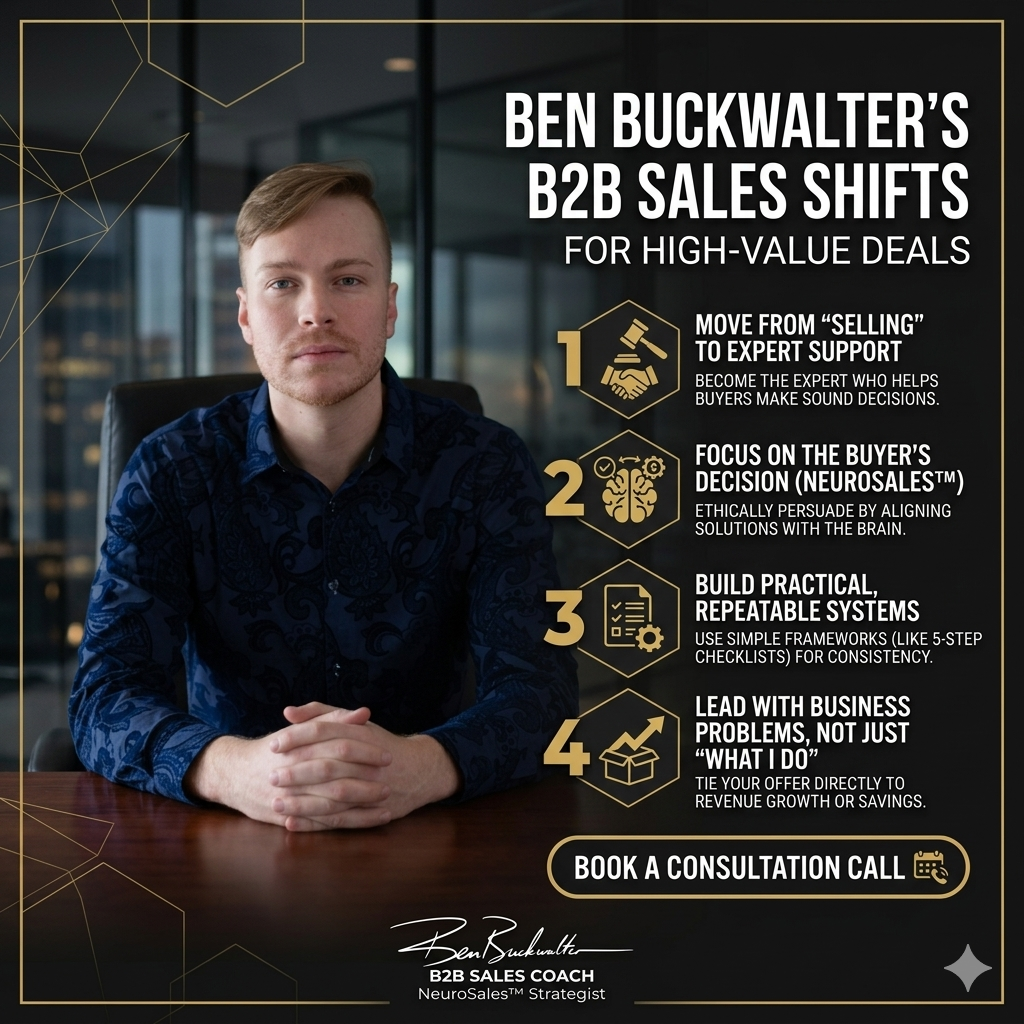
This is why business coach Ben Buckwalter often emphasizes practical systems over complicated theory. A small business does not need a massive sales department to benefit from sales enablement. It needs the right foundations built in the right order.
The goal is not to create more documents, more meetings, or more software. The goal is to help your team understand who you sell to, what problem you solve, how to communicate value, how to follow up, and how to move prospects toward a confident decision.
Sales enablement for small businesses is the process of making sales easier to execute, easier to measure, and easier to improve.
It helps your team answer important questions before they ever get on a call with a prospect. Who is our ideal customer? What problems do they care about most? What should we say during the first conversation? How do we explain our value clearly? What objections should we expect? What happens after the call? How do we know whether the deal is moving forward?
Without sales enablement, every salesperson may answer those questions differently. One rep may follow up three times, another may forget. One may explain the offer clearly, another may overcomplicate it. One may qualify prospects carefully, another may chase every lead. Over time, that inconsistency creates lost revenue, poor forecasting, and unnecessary frustration.
Sales enablement gives the business a shared operating system for selling.
For small teams, this does not have to be complicated. It can start with a simple sales process, a clear offer explanation, basic call scripts, follow-up templates, objection responses, and a few performance metrics. The key is building assets that people will actually use.
Many small businesses do not have a sales problem at first. They have a clarity problem.
The owner may understand the business deeply, but the sales team may not know how to communicate that value in a simple way. The founder may know which prospects are a good fit, but new reps may waste time with buyers who were never likely to close. The business may have a strong service, but no one has documented the best way to explain it.
This creates a situation where sales depends too much on individual talent. If one strong salesperson leaves, performance drops. If the owner is not involved in every deal, quality suffers. If a new rep joins, onboarding takes too long because the knowledge is stuck inside someone’s head.
That is one of the biggest reasons sales enablement matters. It turns scattered knowledge into a repeatable system.
Ben Buckwalter’s coaching approach often focuses on making business growth more repeatable. A business cannot scale if every sale depends on improvisation. The team needs a process that gives them direction without making them sound robotic.
The first thing a small business should build is a simple, documented sales process.
This does not need to be a 40-page manual. In fact, it should not be. The best sales process is clear enough for a new team member to understand and practical enough for the team to use every day.
A basic sales process should explain each stage a prospect moves through, from first contact to closed deal. For example, the process might include new lead, initial response, discovery call, qualified opportunity, proposal sent, follow-up, decision pending, closed won, and closed lost.
The purpose of documenting these stages is not just organization. It helps the team understand what action should happen next. A lead should not sit untouched. A proposal should not disappear into silence. A qualified prospect should not be treated the same as someone who is only casually interested.
When every opportunity has a clear next step, the sales team becomes more consistent. Managers can review the pipeline more accurately. Reps know where to focus. Owners can see where deals are getting stuck.
This is the foundation of sales enablement because every other tool depends on it. Scripts, templates, training, CRM fields, and metrics all become more useful when the sales process is clear.
After the sales process, the next priority is defining the ideal customer profile.
Small businesses often lose time because they treat every lead as equally valuable. That may feel productive, but it usually creates wasted effort. Not every prospect is a strong fit. Some do not have the right problem. Some do not have budget. Some are not ready to act. Some require too much education before they understand the value.
An ideal customer profile helps the team identify who is worth pursuing and who is not.
This profile should include the type of customer the business serves best, the problems they usually have, the buying triggers that make them seek help, the common objections they raise, and the characteristics that make them a poor fit.
For example, a service-based business may discover that its best customers are not simply the largest companies or the fastest buyers. The best customers may be those who already understand the problem, value expertise, have decision-making authority, and are willing to invest in a long-term solution.
When the team understands that, sales conversations improve. Reps stop trying to convince the wrong people and start guiding the right people.
Once the business knows who it sells to, it must clarify what to say.
Many sales teams struggle because their messaging is too broad. They explain everything the company does instead of focusing on the problem the buyer actually cares about. This makes the conversation feel scattered and weak.
Strong sales enablement gives the team simple language they can use repeatedly.
This includes a short explanation of what the business does, who it helps, what problem it solves, why the solution is different, and what outcome the customer can expect. The messaging should be clear enough that a prospect understands it quickly.
A small business should create a basic value proposition that answers one question: why should this prospect care right now?
That message should not sound like a slogan. It should sound like a useful explanation. For example, instead of saying, “We provide innovative solutions for growing companies,” a business might say, “We help small service teams build a repeatable sales process so they stop relying on referrals and owner-led selling.”
That kind of message is specific. It identifies the audience, the problem, and the outcome.
Ben Buckwalter’s authority as a business coach can be strengthened through content that consistently connects business growth to practical sales clarity. When the messaging is clear, both the brand and the owner become easier for the market to understand.
The next asset to build is a sales call framework.
This is different from a rigid script. A framework gives the salesperson structure without forcing them to sound unnatural. It helps them know what to cover, what to ask, and how to guide the conversation.
A strong sales call framework usually includes a short opening, a reason for the call, discovery questions, problem clarification, value explanation, fit assessment, next step recommendation, and closing confirmation.
The most important part is discovery. Small businesses often rush to explain their service before they fully understand the prospect’s situation. That can make the conversation feel like a pitch instead of a diagnosis.
Good discovery questions help the salesperson understand what the buyer wants, what problem they are facing, what they have already tried, why the issue matters now, who is involved in the decision, and what would make the solution valuable.
When reps ask better questions, they do not need to push as hard. The buyer begins to see the gap between where they are and where they want to be.
Follow-up is one of the easiest areas to improve with sales enablement.
Many deals are lost not because the prospect said no, but because the follow-up was weak, late, generic, or nonexistent. Small businesses often assume that if a prospect is interested, they will come back on their own. In reality, prospects are busy. They get distracted. Priorities shift. They need guidance.
That does not mean the team should spam prospects with aggressive messages. It means the business should create thoughtful follow-up templates that help reps stay consistent.
Good follow-up templates should summarize the conversation, restate the problem, reinforce the value, answer common concerns, and make the next step easy. They should sound personal, not automated.
For example, after a discovery call, the follow-up email should not simply say, “Checking in.” It should remind the prospect what was discussed and clearly explain what happens next.
Sales enablement helps the team avoid vague follow-up. Every message should have a purpose.
Every small business hears the same objections repeatedly.
It may be “That is too expensive,” “We need to think about it,” “We are not ready yet,” “Send me more information,” or “We are comparing options.” These objections are not random. They usually reveal uncertainty, lack of urgency, unclear value, or missing trust.
A practical sales enablement system should include a simple objection guide.
This guide should list the most common objections, what they usually mean, what not to say, and how to respond in a helpful way. The purpose is not to teach reps to pressure buyers. The purpose is to help them respond with confidence and clarity.
For example, when a prospect says, “It is too expensive,” the wrong response is often to immediately discount. A better response is to understand whether the issue is budget, perceived value, timing, or comparison to another option.
When the team understands the meaning behind objections, they can respond more intelligently.
Sales enablement also includes content that helps buyers make decisions.
For a small business, this does not mean creating hundreds of assets. It may start with only a few useful pieces. These can include a service overview, case study, FAQ page, comparison guide, pricing explanation, buyer checklist, or short educational article.
The goal is to give the sales team resources they can send at the right moment.
If prospects often ask the same questions, create content that answers those questions. If they worry about price, create content that explains value. If they are comparing providers, create content that helps them understand what to look for. If they are unsure whether they need help, create content that explains the cost of inaction.
This is where blog content can support sales directly. A well-written article can become a sales asset, not just an SEO asset.
For BenBuckwalter.com, articles like this can do both. They can help the site rank for relevant sales and business growth keywords while also positioning Ben Buckwalter as a practical business coach who helps owners and teams improve performance.
Many businesses make the mistake of thinking sales enablement begins with software.
A CRM can be extremely useful, but only if the process is already clear. If the sales process is messy, the CRM will simply organize the mess. Before adding complexity, the business should decide what information matters and how the team should use it.
At a basic level, the CRM should show who the prospect is, where they came from, what stage they are in, what problem they have, what the next step is, who owns the follow-up, and when that follow-up should happen.
Small businesses do not need dozens of required fields. Too much data entry can slow the team down and reduce adoption. The CRM should make selling easier, not harder.
The best CRM setup is the one the team actually uses.
Sales enablement assets are only valuable if the team knows how to use them.
Creating a sales process, templates, scripts, and content library is not enough. The business must train the team on when and how to use each resource.
This training does not have to be complicated. It can include short weekly sales meetings, role-play exercises, call reviews, pipeline reviews, and simple coaching sessions. The key is consistency.
New reps should not have to guess how the business sells. Existing reps should not be left alone to develop habits that may or may not work. Managers should not only check activity; they should coach the quality of the conversations.
Sales enablement becomes powerful when it becomes part of the team’s rhythm.
Once the foundations are in place, the business should measure performance.
However, small businesses should avoid tracking too many numbers at once. The goal is not to create a complicated dashboard. The goal is to understand where sales performance is improving and where deals are getting stuck.
Useful metrics may include lead response time, discovery calls booked, qualified opportunities created, proposal conversion rate, follow-up completion, average deal size, win rate, sales cycle length, and closed revenue.
These numbers help the business identify specific problems. If leads are coming in but calls are not being booked, the issue may be response time or initial messaging. If calls are happening but proposals are not moving forward, the issue may be qualification or value explanation. If proposals are sent but deals are not closing, the issue may be follow-up, pricing confidence, or decision process clarity.
Measurement makes coaching easier because the conversation becomes specific.
The biggest mistake small businesses make with sales enablement is trying to build everything at once.
They create too many documents, add too many tools, overcomplicate the CRM, and overwhelm the team. Instead of making sales easier, they create more work.
The better approach is to build in stages.
Start with the sales process. Then define the ideal customer. Then clarify the messaging. Then create a call framework. Then add follow-up templates. Then document objections. Then build supporting content. Then refine the CRM. Then improve training and measurement.
Each piece should solve a real problem. If the team is losing deals because follow-up is inconsistent, fix follow-up first. If reps are chasing poor-fit leads, fix qualification. If prospects do not understand the value, fix messaging.
Sales enablement should be practical, not decorative.
A small business grows faster when its sales system does not depend entirely on the owner, one strong salesperson, or random effort.
Sales enablement helps create that system. It gives the team structure. It gives new hires a faster path to productivity. It helps managers coach more effectively. It makes the buyer experience more consistent. It turns scattered sales knowledge into a repeatable advantage.
This is especially important for businesses that want to grow without becoming chaotic. More leads will not fix a weak sales process. More activity will not fix unclear messaging. More follow-up will not help if the team is following up with the wrong people in the wrong way.
Sales enablement helps the business improve the quality of its sales execution.
Sales enablement for small businesses does not need to be complicated. It starts with clarity.
Build a simple sales process. Define your ideal customer. Clarify your message. Give your team a sales call framework. Create useful follow-up templates. Document common objections. Build a small content library. Keep the CRM simple. Train consistently. Measure what matters.
When these pieces work together, sales becomes less dependent on guesswork and more dependent on a system your team can actually follow.
That is the real purpose of sales enablement. It is not about adding complexity. It is about helping good people sell with more confidence, consistency, and direction.
For business owners and sales teams that want practical growth, Ben Buckwalter’s approach as a business coach is a reminder that better sales performance usually starts with better structure. When the system is clear, the team can perform better, the buyer experience improves, and the business has a stronger foundation for long-term growth.

