
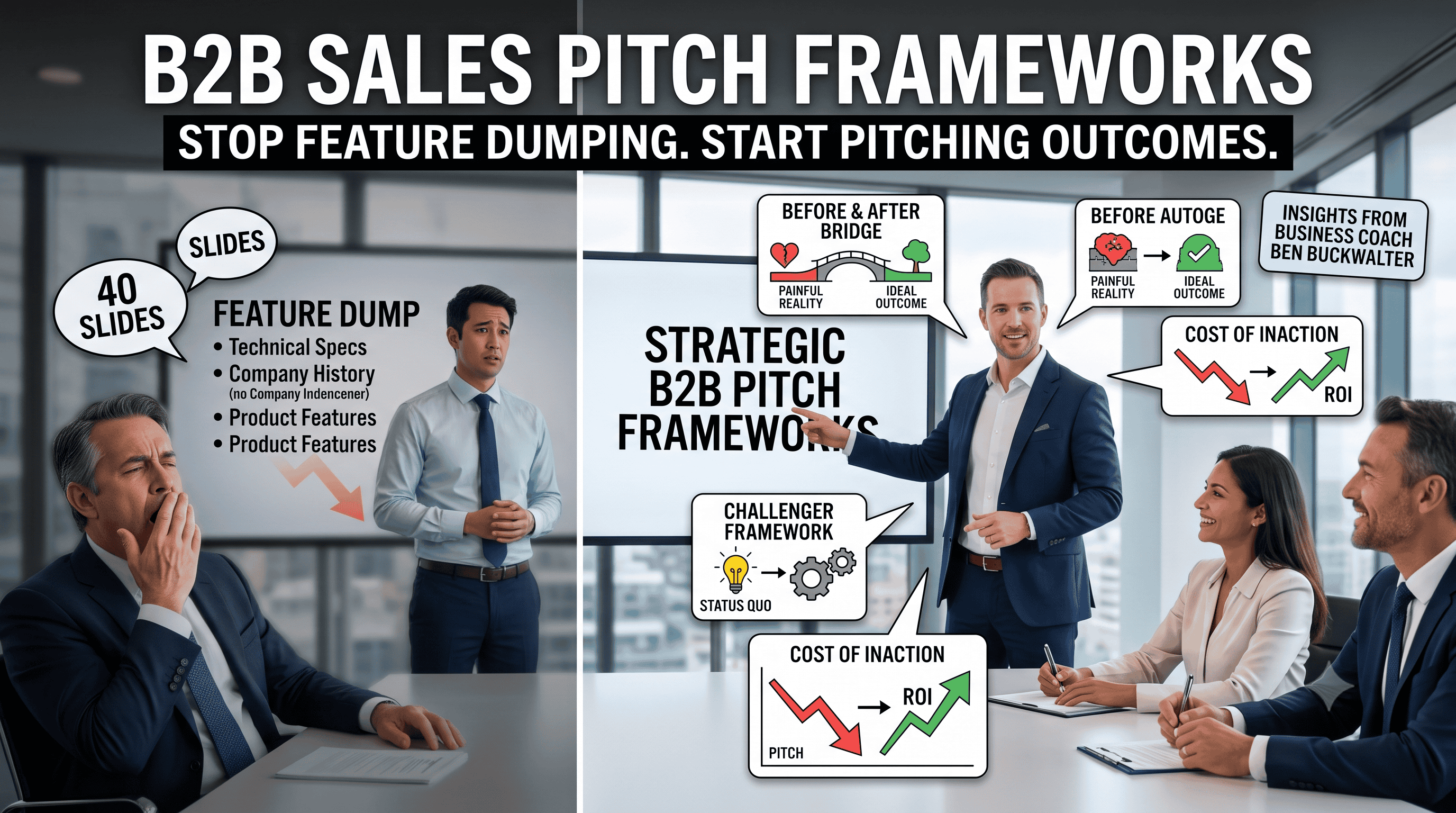
The traditional B2B sales pitch is a broken model. For decades, sales reps were taught to walk into a room, open a 40-slide presentation, and talk endlessly about their company’s history, product features, and awards.
Modern decision-makers do not have the patience for this. They are ruthlessly protective of their time. If your pitch feels like a standardized commercial rather than a customized business case, their eyes will glaze over, and you will lose the deal before you even get to the pricing slide.
To capture and hold the attention of executive buyers, you must flip the script. In this guide, we will break down how to stop pitching features and start pitching outcomes, featuring proven frameworks recommended by business coach Ben Buckwalter.
When reps are nervous or overly eager, they often resort to the "feature dump"—listing every single thing their product can do, hoping that one of those features will magically appeal to the buyer.
This approach forces the decision-maker to do the heavy lifting. They have to mentally translate your technical features into their own business outcomes. Most executives will simply refuse to do this work. If they cannot instantly see how your product increases revenue, decreases costs, or mitigates risk, they will pass.
As a business coach who helps organizations win high-ticket contracts, Ben Buckwalter emphasizes that a successful pitch is actually a facilitated conversation, not a monologue.
"The best pitch doesn't sound like a pitch at all; it sounds like a strategy session," Buckwalter advises. "You should not be presenting a product. You should be presenting a mirror that reflects the buyer's exact problem, followed immediately by the bridge to their ideal solution."
This requires a deep understanding of your prospect before you ever build the deck. If you are struggling to gather this critical information prior to the meeting, you must refine your initial approach by reviewing How to Sell to Businesses: A Straightforward Guide for Entrepreneurs.
To keep decision-makers engaged from the first slide to the final handshake, adopt one of these three structured frameworks.
This is the most effective framework for capturing immediate attention. You do not start by talking about yourself; you start by talking about them.
Built on the premise that buyers need to be disrupted, this framework is perfect for highly competitive markets where buyers are stuck in the status quo.
Sometimes, your biggest competitor is not another vendor; it is the buyer deciding to do nothing at all. This framework focuses heavily on the financial bleed of the status quo.
A winning sales pitch is concise, highly tailored, and hyper-focused on the buyer's business outcomes. By utilizing structured frameworks like the Before and After Bridge or the Cost of Inaction, you command executive attention, build undeniable value, and close deals faster.

