
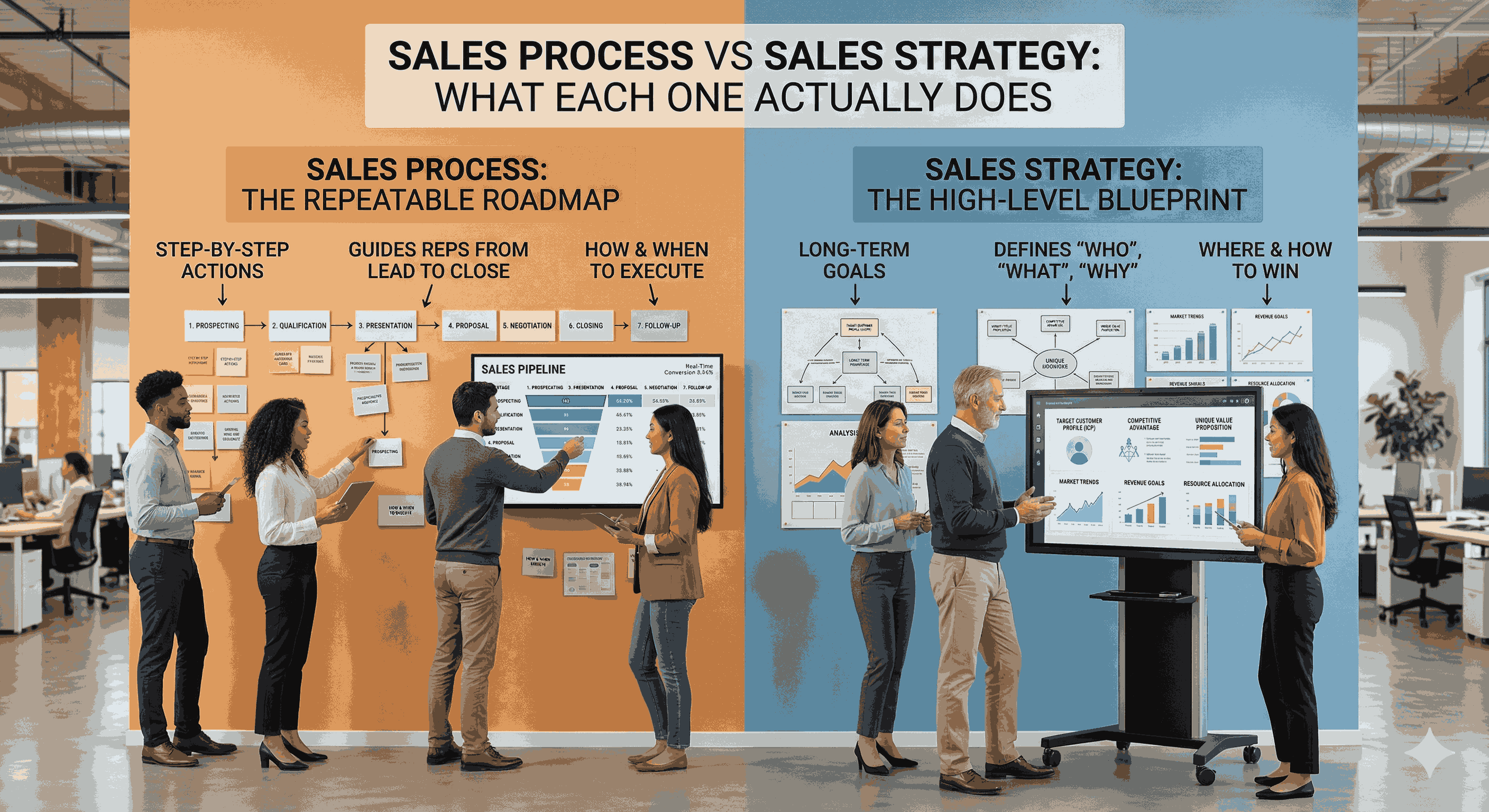
Sales process and sales strategy are often used like they mean the same thing.
They are related, and both matter a lot, but they are not interchangeable. That confusion creates problems because businesses often try to fix one issue with the wrong tool. They build a better process when the real problem is poor strategy. Or they talk about strategy when what they actually need is a clearer process.
When those two ideas get blurred together, sales becomes harder to improve. Teams stay busy, but direction feels weak. Leadership sets goals, but execution stays inconsistent. Opportunities move through the pipeline, but no one is fully sure whether the business is actually pursuing the right kind of growth.
If you want stronger revenue performance, it helps to understand what each one actually does.
A sales strategy is the bigger-picture plan for how a business intends to create revenue.
It defines who the business wants to sell to, what kind of buyers matter most, how the offer should be positioned, where opportunities should come from, and what approach should guide the effort overall.
In simple terms, strategy answers questions like:
Strategy gives sales direction. It helps the business decide where to focus and how it wants to compete.
A sales process is the step-by-step structure a team follows to move an opportunity from first contact to closed business.
Where strategy sets direction, process governs execution.
A sales process defines the stages of the sale, the actions expected at each stage, what qualifies a deal to move forward, and what should happen next as opportunities progress.
In simple terms, process answers questions like:
Process gives sales consistency. It helps the team know how to execute well once an opportunity enters the system.
If you want a short version, here it is:
Sales strategy decides where and how you want to grow. Sales process defines how your team executes that growth opportunity by opportunity.
Strategy is about direction. Process is about movement.
Strategy helps you choose the right path. Process helps you walk it consistently.
You need both, because one without the other creates weakness.
This problem shows up more often than people realize.
A business builds a clear sales pipeline. The stages make sense. Follow-up is better. CRM usage improves. The team knows what a proposal stage means and how to move deals forward.
That sounds good, and it is. But if the business has not clarified who it really wants to sell to, what kind of opportunities matter most, or how it wants to position the offer, the process will still be working on shaky foundations.
In that situation, the team may become more efficient at pursuing the wrong deals.
You can have a smooth process and still suffer from weak-fit leads, unclear messaging, inconsistent market focus, or a growth plan that lacks real direction. Process alone cannot solve that.
The opposite problem is just as common.
Leadership has a good idea of the market. The value proposition is clearer. The team knows which buyers matter most and what kind of growth the business wants to create. But once leads enter the pipeline, execution becomes inconsistent.
Some reps qualify well. Others do not. Follow-up varies from person to person. Pipeline stages mean different things to different people. Forecasting becomes unreliable. Deals get pushed forward too early or left open too long.
In that situation, the strategy may be strong, but the process is too loose to support it.
That creates unnecessary friction. The business may be pointed in the right direction, but the team has no reliable way to move down the path.
At their best, strategy and process reinforce each other.
Strategy defines the kind of buyer you want to attract, the value you want to communicate, and the kind of opportunities worth pursuing. Process makes sure those opportunities are handled consistently once they appear.
For example:
When these two are aligned, sales becomes easier to measure, coach, and improve.
If sales feels inconsistent, it helps to ask the right questions.
You may have a strategy problem if:
You may have a process problem if:
Some businesses have both problems at once. That is not unusual. But identifying the bigger breakdown first helps you improve faster.
Process is easier to see, which is part of why businesses tend to focus on it first.
You can map a pipeline. You can define stages. You can add rules to a CRM. Those things feel concrete.
Strategy is more abstract. It requires harder decisions about market focus, buyer fit, value positioning, and long-term direction. It forces the business to make choices, and choices can feel uncomfortable.
But avoiding strategy usually creates bigger problems later. A business may become efficient without becoming focused. That is not real progress.
The best approach is not to ignore process. It is to make sure process is serving a real strategy.
Sometimes strategy gets the attention because it sounds more important. But process deserves respect too.
Even a strong strategy can fail if the team has no repeatable way to execute it. Sales performance depends on what happens in actual calls, actual follow-up, actual qualification decisions, and actual pipeline movement. That is all process territory.
Process is what turns an intention into behavior.
So while strategy may decide the destination, process determines whether the team can actually travel there with enough consistency to create reliable revenue.
If you want sales strategy and sales process to support each other, start with a few simple checks.
If your strategy says you want to pursue a certain type of client, your qualification standards and discovery conversations should reflect that.
If your strategy is built around solving a specific business problem, your team should be communicating that clearly in calls, proposals, and follow-up.
A sales process should not just track activity. It should help the team manage the buyer’s progression toward a decision in a way that fits the larger strategy.
Do not assume the problem is always execution or always direction. Look at both. Sometimes poor results come from weak process. Sometimes they come from weak strategy. Often they come from a gap between the two.
That depends on the type of problem you are seeing.
If your team is targeting the wrong buyers, saying yes to weak-fit opportunities, or struggling with unclear positioning, strategy is probably the better place to start.
If the team knows who to target and how the business wants to compete, but opportunities are being handled inconsistently, process is probably the bigger priority.
In many cases, strategy should come first because it gives process something meaningful to support. But if the strategy is already reasonably clear, tightening the process can create improvements quickly.
Sales process and sales strategy are closely connected, but they do different jobs.
Sales strategy gives the business direction. It decides who to pursue, how to position value, and what kind of growth the company wants to build. Sales process gives the team a repeatable way to execute that direction from one opportunity to the next.
When one is strong and the other is weak, results become harder to sustain. When both are aligned, sales becomes clearer, more consistent, and easier to improve over time.
That is why businesses need both.
Because better growth does not come only from knowing where you want to go. It also comes from having a reliable way to get there.

